The best places to see the northern lights in Norway are Tromsø, Alta, the Lofoten Islands, Senja, Narvik and Svalbard, all far north of the Arctic Circle where the aurora appears regularly on dark, clear nights. In Iceland, the best viewing is outside Reykjavik, in places such as Thingvellir National Park, the Snæfellsnes Peninsula and North Iceland. The season runs roughly from late August or September to March in Norway and to April in Iceland, and the best viewing is usually between 11 pm and 2 am. Clear skies matter as much as location, so plan several nights.
Where can you see the northern lights?
The aurora borealis appears in a ring around the Arctic, so you need to be at high northern latitude, away from city lights, on a clear dark night. Northern Norway, Iceland, northern Sweden and Finland, Arctic Canada and Alaska are the main destinations. For travellers from the UAE, Norway and Iceland are the most practical because of their tourist infrastructure and flight connections through Europe.
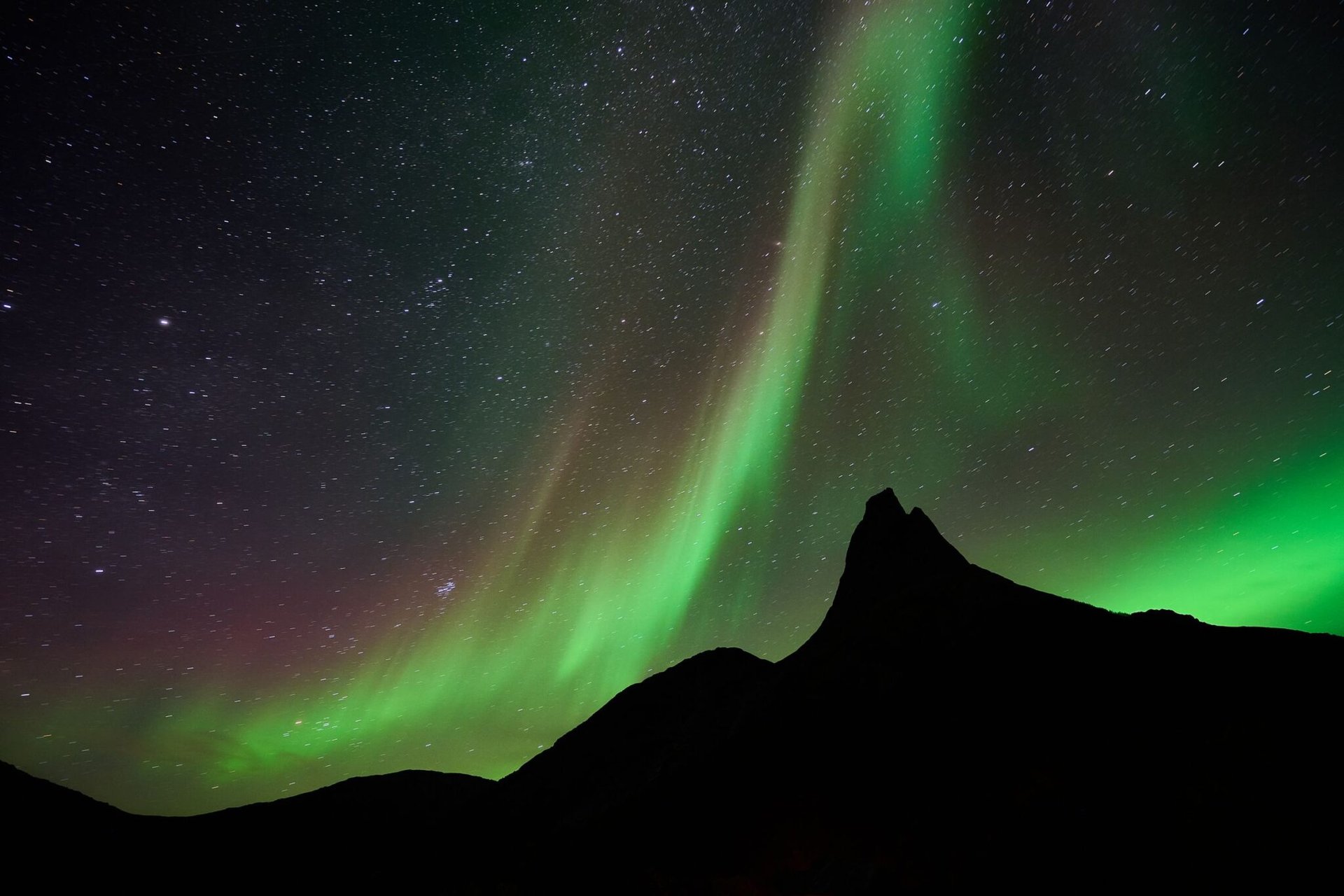
The lights form when charged particles from the sun are pulled into the atmosphere by the Earth’s magnetic field and collide with oxygen and nitrogen, producing mostly green light, sometimes with pink, blue or violet.
Best places to see the northern lights in Norway
Visit Norway lists these as the leading aurora destinations:
- Tromsø: the main hub, with direct international flights, many guided aurora tours and easy escapes to dark fjords such as Ersfjord and the island of Kvaløya. It gets busy in winter, so consider autumn.
- Alta: a quieter alternative to Tromsø, further north-east in Finnmark.
- Lofoten Islands: dramatic mountains and beaches, often combined with Vesterålen and whale watching.
- Senja: a large island close to Tromsø but far less crowded.
- Narvik: lets you combine alpine skiing with aurora viewing.
- Svalbard: high-Arctic islands with polar night in the darkest months.
Another option is the coastal ship route between Tromsø and Kirkenes, which takes you away from light pollution and lets you watch from deck.
Which is the best place in Norway for a first trip?
Tromsø is the easiest first choice. It has the most flights, hotels and guided tours, and tour operators drive out to wherever the sky is clearest. If you want fewer people, pick Alta or Senja. If you want daytime scenery as good as the nights, pick Lofoten.
Best places to see the northern lights in Iceland
Iceland is smaller and the whole country lies at a latitude where the aurora is often visible, so the main job is to get away from light pollution.
- Around Reykjavik: you can sometimes see the aurora from the city, but a 30 to 60-minute drive out, for example to Thingvellir National Park, makes a large difference.
- Snæfellsnes Peninsula: mountains, lava fields and coast, a few hours from Reykjavik.
- South Coast: waterfalls and black-sand beaches, with many countryside hotels.
- North Iceland: the Lake Mývatn area and Akureyri, often with different weather from the south.
- Westfjords: remote and very dark, but harder to reach in winter.
Visit Iceland points travellers to the Icelandic Met Office aurora and cloud-cover forecast, which is the most useful tool for choosing where to go each night.
When is the best time to see the northern lights?
You need darkness, so summer is out: around midsummer the Arctic has the midnight sun and the sky never gets dark enough.
- Norway: Visit Norway gives the season as late August to late March, with the highest statistical activity around the equinoxes in September–October and March.
- Iceland: Visit Iceland gives the main season as September to April, with activity said to peak around the equinoxes and the longest dark hours in midwinter.
- Time of night: the best window is usually between 11 pm and 2 am, but displays can happen any time it is dark.
We are currently in an active part of the sun’s roughly 11-year cycle, which improves the odds of strong displays.
Is February or March better for the northern lights?
Both are good. February has longer nights and full winter scenery, which suits dog sledding and snow activities. March brings longer days for sightseeing and still has plenty of darkness, with activity often high around the March equinox. Weather, not the month, usually decides whether you see anything, so stay at least three to four nights.
Norway or Iceland: which is better for the northern lights?
| Factor | Northern Norway | Iceland |
|---|---|---|
| Main bases | Tromsø, Alta, Lofoten, Senja | Reykjavik, South Coast, Akureyri |
| Landscape | Fjords, Arctic coast, mountains | Lava fields, glaciers, waterfalls, geothermal pools |
| Season (official tourism boards) | Late August to late March | September to April |
| Getting there from the UAE | Emirates nonstop to Oslo, then a domestic flight north | Connect through a European hub |
| Daytime activities | Dog sledding, whale watching, Sami culture, skiing | Golden Circle, ice caves, hot springs, glacier walks |
Choose Norway if you want a city base with lots of tours and Arctic winter activities. Choose Iceland if you want to combine the aurora with a road trip past volcanic scenery.
How to read the northern lights forecast
Three things decide your chances on a given night:
- Cloud cover: the most important factor. Use the Norwegian Meteorological Institute (yr.no) or the Icelandic Met Office cloud maps to find clear skies.
- Geomagnetic activity: shown as the Kp index on a 0–9 scale. At Arctic latitudes like Tromsø, even moderate values can produce a visible display; higher values bring brighter, more active lights.
- Darkness: avoid towns, and note that a full moon washes out faint displays.
Guided tour or self-drive?
A guided “aurora chase” is the easiest option for a first trip. Guides watch the forecasts, drive to clear skies, and usually provide warm clothing and photos. Self-driving gives more freedom, but winter roads in the Arctic can be icy and dark, so only drive if you are comfortable with snow and ice, and check road conditions before you leave. You can compare aurora tours and day trips on Ziarah activities.
Can you see the northern lights on a honeymoon in Iceland or Norway?
Yes, if you travel in the dark season and give yourselves enough nights. Many couples book a glass-roofed cabin, a remote lodge or a few nights in Tromsø or the Lofoten Islands, and join one guided chase early in the trip so there is time to try again. In Iceland, pairing aurora nights with hot springs and the South Coast works well for a slower, couple-focused itinerary.
Getting there from Dubai and Abu Dhabi
Emirates flies nonstop from Dubai to Oslo in about 7.5 hours. From Oslo, connect on a domestic flight to Tromsø or another airport in the north. For Iceland, fly to a European hub and connect to Keflavík, Reykjavik’s international airport. Search connections on Ziarah flights, and if you choose Iceland, compare Reykjavik hotels as a first base.
Photographing the northern lights
- Use a tripod or rest your phone on something solid.
- On a phone, use night mode or a manual mode with an exposure of several seconds.
- On a camera, start with a wide lens at its widest aperture, focus at infinity, ISO 1600–3200 and exposures of 5–15 seconds, then adjust.
- Include a foreground such as a mountain, cabin or shoreline.
- Carry spare batteries in an inside pocket; cold drains them quickly.
What to pack
Dress in layers: thermal base layers, a fleece or down mid-layer, and a windproof, waterproof outer layer. Add insulated boots with good grip, a warm hat, gloves you can operate a phone in plus mittens over them, and a head torch. Hand warmers and a flask of a hot drink make long waits easier.